

When a new device arrives, the most immediate question is almost always the same: what can it do?
With the new Meta Glasses and Meta VR Glasses, however, it is worth starting with a different question: which experience could become simpler if we no longer had to rely on a smartphone or computer every time?
This is an important distinction. Technology can be spectacular, but its value depends on the context in which it is used.
In 2026, Meta expanded its wearable technology strategy with several different products.
The New Meta Glasses Are Not One Single Category
On one side are AI Glasses, such as the new Ray-Ban Meta and Meta Glasses lines: eyewear designed for listening to music, making calls, interacting with an AI assistant and performing certain actions without directly using a phone screen.
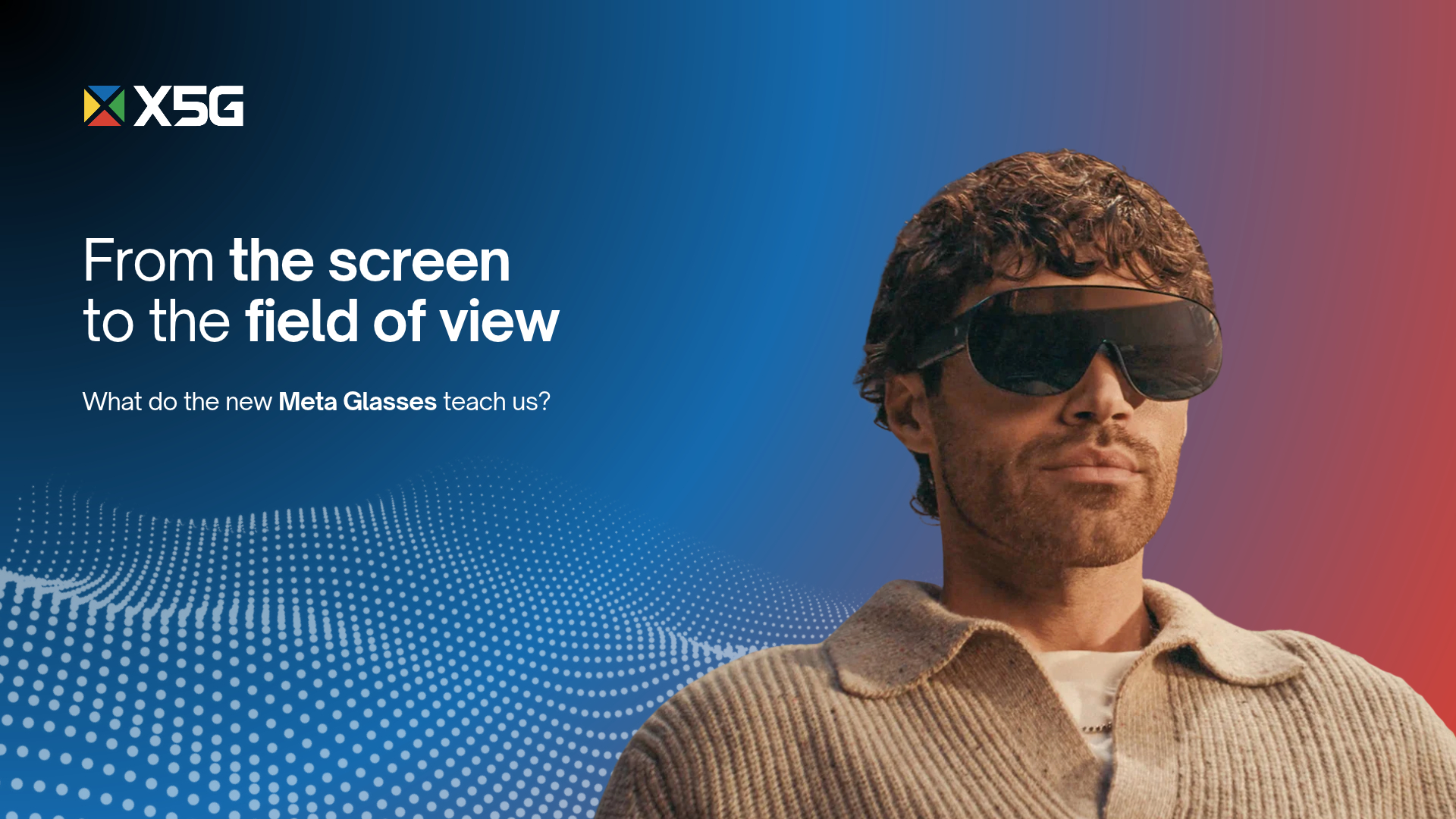
On the other side are the Meta VR Glasses, presented at Meta Connect 2026 as a new format for virtual reality. Meta describes them as a lightweight device designed for cinema, live sports, workspaces and spatial computing. They are expected to become available in spring 2027.
These categories should not be confused. AI Glasses aim to bring an assistant into everyday life. VR Glasses aim to bring users into a more immersive digital environment.
What they have in common is the move beyond the traditional screen as the only place where interaction happens.
The Innovation Is Not the Device, but the Context
For years, we have designed digital experiences primarily for desktops and smartphones. We have organised menus, pages, product sheets, forms and notifications inside glowing rectangles.
Wearable devices change several fundamental conditions:
- the user may be on the move;
- their attention may be shared with the real-world environment;
- the time available to read or make a choice may be very short;
- voice, audio, gaze or gestures may become part of the interaction;
- privacy and the perception of people around the user become more important.
This means that simply transferring a web page to a new device is not enough. We need to rethink the hierarchy of information, the moment when an action is proposed and the level of control given to the user.
A New Interface Is Not Automatically a Solution
A company may be tempted to ask whether it should develop an experience for the new glasses. But first, it should understand which problem it wants to solve.
Does a field technician need to quickly consult a procedure? Does a customer need to receive instructions without interrupting an activity? Does a sales team need to demonstrate a product in a real-world setting? Does a company want to train its people in a simulated environment?
In these cases, a new interface could make sense. But only if it removes a step, makes information more accessible or improves a concrete activity.
If the problem is instead a confusing catalogue, a difficult form or a website that does not communicate the service clearly, adding a new device will not solve the underlying issue. A clear digital foundation is needed first.
Content Comes First
One of the most interesting consequences of hands-free and immersive devices concerns content.
When someone views a website on a desktop, they can compare a large amount of information at the same time. When they hear a response or receive an indication in their field of view, the content needs to be more selective.
This requires:
- short, understandable information;
- consistent labels;
- predictable user journeys;
- up-to-date and verifiable data;
- accessible alternatives for people who cannot or do not want to use voice, gestures or a headset;
- a clear distinction between an automated suggestion and the user’s decision.
The same principle applies to a good website and a good e-commerce experience: technology can speed up access, but it cannot replace the organisation of information.
From AI to Experience: Where Human Oversight Matters
The new generations of AI Glasses make it more natural to talk to an assistant and ask questions about the surrounding world. This can be useful, but it also introduces new responsibilities.
A system that describes an environment, suggests an action or answers a question must be transparent about its limitations. It should not present unverified information as certain or turn a hypothesis into an operational instruction.
Human supervision therefore remains important at least in four stages:
- Design: deciding which problem genuinely deserves an AI interaction;
- Content: checking data, terminology, tone and sensitive information;
- Interface: making it clear what the system is doing and how to stop it;
- Evaluation: checking whether the experience is genuinely useful for the people involved.
In its guidance on AI-generated content, Google also emphasises quality, originality and usefulness for people, rather than using AI as a shortcut to produce large quantities of pages.
The direction is similar: what matters is not only how content is generated, but why it exists and what value it provides.
What This Means for Companies
For most companies, the first step is not choosing between a website, an app, AI Glasses or VR Glasses.
The first step is mapping the part of the journey that currently creates the most friction:
- finding a product or service;
- understanding a procedure;
- requesting a quote;
- consulting a technical catalogue;
- booking an appointment;
- training a person;
- receiving assistance when it is needed.
Only afterwards can a company assess which interface is most suitable. In some cases, a better-organised website will be enough. In others, an app, web app, integration or immersive experience may be appropriate.
The device comes after the problem, not before it.
The Future of Interfaces Is a Design Question
The new Meta Glasses point towards a clear direction: digital interaction is becoming closer to context, more continuous and less tied to a single screen.
But this evolution does not make the basic principles less important. On the contrary, it makes them even more important:
- understanding people;
- reducing complexity;
- designing useful content;
- protecting privacy and autonomy;
- connecting technology with real processes;
- verifying that every new feature actually solves a problem.
For this reason, talking about new interfaces means talking about experience first and foremost. The work does not begin with the hardware; it begins with the right question.